

I attended a two-week, digital-free Jungian workshop earlier this year. I didn’t know anyone there and was unfamiliar with the approach of the facilitator. I felt like there was little guidance and input from the facilitator, and all manner of memories and crises presented themselves to me to address on my own: early childhood memories, uninformed decisions that I’d made that had deleterious consequences, painful insights about my relationship with my parents. I very much felt alone, and caught myself so many times looking for my phone to look up something or call Howard. After two weeks, when asked to share in no more than one sentence what I walked away with, I was shocked that the words: “I’ve learned to trust my inner authority” came out of my mouth. I’d had no idea what I was going to say, so much had happened for me. It’s not like I’d been thinking about inner authority anytime before I spoke it. Hearing those words gave me a profound realization of how much I’d previously needed validation and guidance external to me. This was an amazing gift to recognize that I have what I need to guide my own life forward.

The distinction between inner authority and external authority is decidedly one of the topics that has emerged as a touchstone in my exploration about wisdom: where we go to make decisions, and what voices we listen to, believe, and act upon. I don’t think a useful distinction is that our inner is good, and the outer bad. External authority isn’t the problem in itself. Teachers, traditions, elders, research, and the people who love us all carry knowledge we don’t have, and a woman who refuses all outside input isn’t wise, she’s just isolated. The problem is when external authority becomes the default setting: when we check outside ourselves first, and our own knowing has to get permission or validation before it’s allowed to count. For many women, especially those raised to be good, agreeable, and useful, that permission was rarely given. So the muscle of inner authority never got built, and the outer voices got installed so early these ‘expert voices’ feel like our own thoughts.

A more useful distinction is discernment, rather than jumping fully into one camp or another. A few questions help in our quest for finding the right path, whether the question is should I take my 90 year old father’s 10th phone call of the day, pay my child’s rent for the next 3 months while she’s still looking for a job (but not that I can tell), or should I end my marriage that has quietly gone flat.
Whose voice is this? Much of what feels like “my inner voice” is an internalized parent, a boss, some or many institutions that I’ve been involved in, or a culture that moved in and stayed. The skill in discernment starts with telling those voices apart from your own. ‘Who trained that voice’ is a good question to start with.
Is this intuition or fear? Both show up as strong inner signals. In my experience, fear tends to be urgent, loud, and focused on protecting. If we pay enough attention to our process, our minds do a great job at giving us reasons and justifications to do/not take action on something. Intuition tends to be quieter, steadier, and it doesn’t argue. It’s the voice that keeps returning, time and time again. Listen to that when it happens!
Am I consulting or deferring? Healthy inner authority can take in advice, research, and other people’s wisdom, and still make the final call. Deferring means handing over the decision itself, often to avoid being responsible if it goes wrong.

There’s a real risk in overcorrecting if we skip the humility part to fully “trust yourself.” You can slide into a kind of spiritual certainty where nothing outside you can challenge what you believe is your inner voice or authority. This can be reckless. Some of our deepest conditioning feels like truth precisely because it’s so familiar. Real inner authority does include humility: I trust my knowing and I stay open to a different perspective. This is why naming and turning towards a wisdom council – an intentional naming of people in your circle and sources of knowledge that you respect – is a way of drawing on others for guidance and advice without handing them the steering wheel of your life.
Inner authority is a practice built on consciousness and repetition more than in insight. Small acts count: saying no without explaining, noticing a body signal and honoring it, making a decision without polling five friends first. Each time, the inner voice gets a little more credible. Silence helps too, because it’s hard to hear your own knowing when the outside world never stops talking.
I’m really glad that I had the opportunity to sit with myself for as long as I did, that I WAS able to discern between the voices, and that I learned the tenor of each. I’m hoping the same for you. You can begin by asking yourself: whose voice is loudest in my head right now? Write back and tell me; I read every one. You can also try to make one decision this week without polling anyone and notice what happens. Let me know what happens too!
If this stirred something in you, we host monthly, complementary wisdom sessions, third Thursday at 7 p.m ET, so come and join us!
With love as always,
Leslie
|
||||||||||||||
|
|
||||||||||||||
|
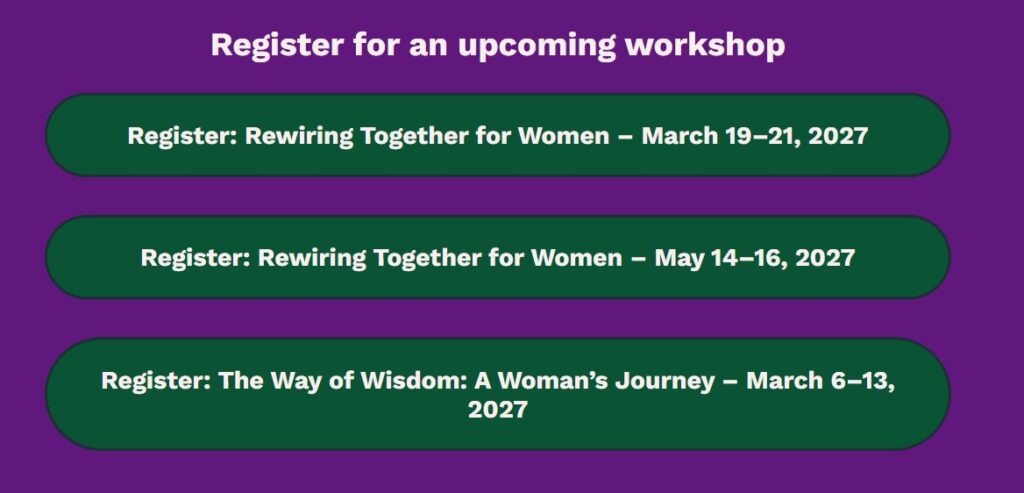
2027 Dates for Rewiring Together Programs
|
||||||||||||||
|
|
||||||||||||||
Join Sandy and me again at the Omega Institute for Rewiring Together for Women, September 19-24!!I am so very excited to have been invited back to teach this year at Omega, together with Sandy Harris! It’s the Queen program you know and love, just extended over 5 days so you can take advantage of all the great activities offered by the Institute in the course of the week and have a more spacious experience. Save the dates: September 19-24, 2027! |